
-
T304 Stainless Steel V-Band Flange Tubing 3" O.D. - Vibrant 1491
Regular price $86.99Regular priceUnit price per -
Stainless Steel V-Band Clamp 3" O.D. - Vibrant 1491M
Regular price $31.75Regular priceUnit price per -
V-Band Clamp Replacement Fastener Set - Vibrant 11146K
Regular price $11.79Regular priceUnit price per -
T304 Stainless Steel V-Band Flange Tubing 2.5" O.D. - Vibrant 1490
Regular price $86.99Regular priceUnit price per -
Aluminum V-Band Flange 3" O.D. - Vibrant 11491M
Regular price $25.50Regular priceUnit price per -
Aluminum V-Band Flange 3" O.D. - Vibrant 11491
Regular price $72.99Regular priceUnit price per -
Aluminum V-Band Flange 3" O.D. - Vibrant 11491F
Regular price $25.50Regular priceUnit price per -
Aluminum V-Band Flange 2.5" O.D. - Vibrant 11490
Regular price $68.99Regular priceUnit price per -
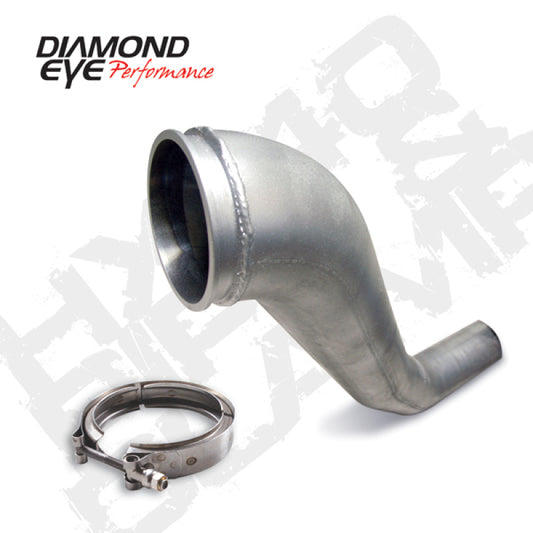
Diamond Eye HX40 Downpipe & V-Band Clamp Kit For 94-02 Cummins 5.9L
Regular price $152.36Regular priceUnit price per -
Stainless Steel V-Band Clamp - Vibrant 19887C
Regular price $45.50Regular priceUnit price per -
Female V-Band Flange - Vibrant 12494F
Regular price $134.99Regular priceUnit price per -
V-Band Titanium Flange Assembly for 5.00 in. O.D. Tubing - Vibrant 12494
Regular price $284.99Regular priceUnit price per -
V-Band Style Inlet Flange for Tial 60mm Wastegate - Vibrant 14963
Regular price $31.99Regular priceUnit price per -
V-Band Style Outlet Flange For Tial 44mm External Wastegate - Vibrant 12410
Regular price $46.99Regular priceUnit price per -
304 Stainless Steel V-band Turbo Inlet Flange - Vibrant 19887
Regular price $34.99Regular priceUnit price per -
304 Stainless Steel V-Band Outlet Flange - Vibrant 19888
Regular price $34.99Regular priceUnit price per -
304 Stainless Steel V-band Turbo Inlet Flange - Vibrant 19862
Regular price $51.75Regular priceUnit price per -
Turbo V-Band Outlet Flange for Garrett GT4202/4294 - Vibrant 19883
Regular price $51.75Regular priceUnit price per -
V-Band Turbo Outlet Flange for Garrett GT4202, 4294, 42974R, 4508R, GTX4508R - Vibrant 19882
Regular price $41.79Regular priceUnit price per -
V-Band Turbo Outlet Flange for Garrett GTX5533R T6 Turbo - Vibrant 19866
Regular price $37.04Regular priceUnit price per -
V-Band Turbo Outlet Flange for Garrett GTX5533R SFI Turbo - Vibrant 19865
Regular price $37.04Regular priceUnit price per -
Quick Release V-Band Clamp, for use with Part #19861 - Vibrant 19861C
Regular price $40.99Regular priceUnit price per -
V-Band Turbo Inlet Flange for Garrett GTX2860R and 2867R - Vibrant 19861
Regular price $33.24Regular priceUnit price per -
Turbo V-Band Outlet Flange for Garrett GT4708/4718/5008/5018/5518/5533 - Vibrant 19847
Regular price $51.75Regular priceUnit price per
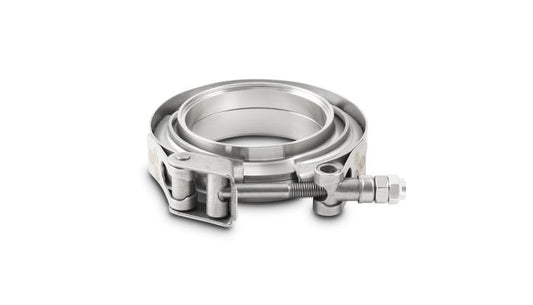


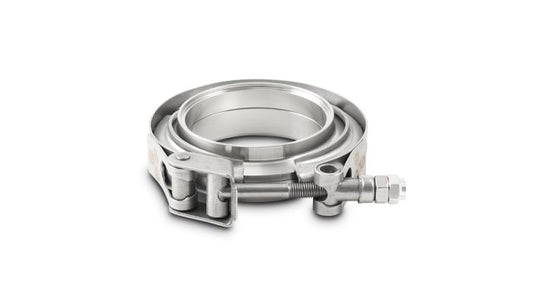
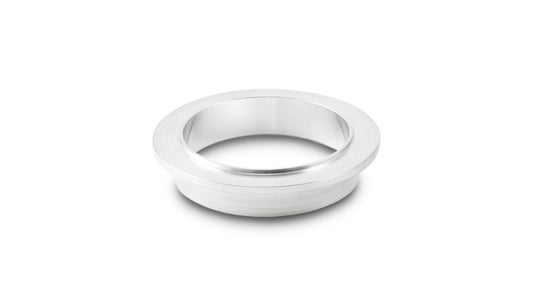

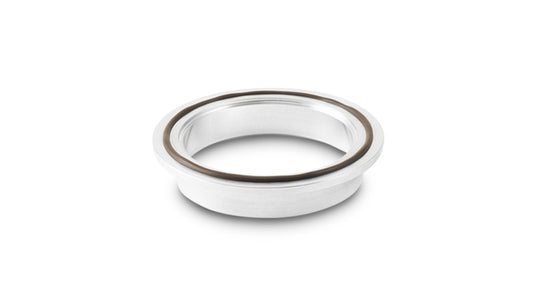




A V-band clamp joins two pieces of tubing with one nut, seals metal to metal, and comes apart in seconds, which is why it has become the standard joint on turbo outlets, downpipes, intercooler piping and race exhausts. Radiant Speed Works stocks the Vibrant Performance V-band clamps and matching flange assemblies in stainless steel, aluminum and titanium, from small turbo outlets up to 6 inch exhaust.
Clamp and flange assemblies
A complete V-band joint is two flanges and a clamp. Vibrant sells the clamps alone for replacement and as assemblies with male and female flanges already matched to each other. The male and female profile locates the joint and seals without a gasket, and it keeps the two sides concentric so tubing lines up as it is welded.
Sizing a V-band
V-band clamps and flanges are sized to the tubing outside diameter they weld to, so a 3 inch assembly fits 3 inch O.D. tubing. Turbo-specific V-bands are a separate case. Garrett GT and GTX outlets, TiAL wastegates and other components use their own profiles, so order by the turbo or wastegate model rather than the pipe size.
Stainless, aluminum or titanium?
Stainless steel V-bands are the choice for exhaust and turbo hot side joints, where heat would soften aluminum. Aluminum V-bands are lighter and weld directly to aluminum intercooler and charge piping. Titanium flanges match titanium exhaust systems for builders chasing weight.
Quick release clamps
Quick release V-band clamps swap the threaded T-bolt for a latch, so a joint can be opened without tools. They are a good fit on race cars that pull the exhaust or turbo often, and on intercooler piping that has to come off for engine work.
Installing V-bands correctly
Tack the flanges to the tubing with the clamp installed so the joint stays aligned, then finish weld in short passes to keep the flange from distorting. Torque the clamp to the maker's spec, tapping around the band as you tighten so it seats evenly. On hot side joints, use anti-seize on the threads.
Common questions
Do V-band clamps leak? A correctly welded and seated V-band seals very well. Leaks usually come from a flange pulled out of round during welding or from mixing flanges from different makers with different profiles.
Can I reuse a V-band clamp? Yes, in most cases. Replace it if the band is stretched, the threads are galled or it no longer closes tight.
What is the difference between a V-band clamp and a band clamp? A band clamp squeezes overlapping or butted tubing, while a V-band pulls two machined flanges together, which gives a stronger, leak-free and easily serviced joint.